


Ever felt that tiny impact of panic when your “free” email-sending plan suddenly slaps you with a high fee? Or maybe you’ve wondered why your newsletter keeps landing in spam folders. I’ve been there, and so have thousands of others. The good news? There’s a surprisingly simple escape hatch: open-source SMTP servers that you can self-host.
SMTP is the postal service of the internet; your emails get stamped, sorted, and delivered by it. When you run your own SMTP server instead of renting space on someone else’s, you get three big wins: zero per-message fees, total control over your sender reputation, and the comfort of knowing no third party is peaking at your data.
Today, I will show you the best, tested and trusted open-source SMTP servers you can install on your server to power your marketing and transactional emails, from the battle-tested Postfix to the sleek newcomer Maddy.
What is an SMTP Server?
An SMTP (Simple Mail Transfer Protocol) email server is a software application that allows you to send, receive, and manage email messages. SMTP is a protocol used for sending emails from one server to another, and it’s a fundamental component of the email communication process. An SMTP server facilitates the routing, delivering, and relaying of email messages across different domains and networks.
If you’re running an online business and want to send out emails to your customers whenever you have new content, products available or important updates to share. Just like you use your email account, such as Gmail, to send and receive messages, your online business also needs a way to send emails to your customers’ inboxes. This is where an SMTP server comes in. An SMTP server is like a middleman that ensures your emails reach their destinations correctly.
Why Self-Host Your SMTP Server?
Let’s say you run a small business, a personal blog, or even a side project that sends emails, like password resets, newsletters, or notifications. You’ve probably used services like Gmail, SES, SendGrid, or Mailgun to handle that. They’re convenient, sure. But have you ever stopped to ask: Who controls my emails?
That’s where open source and self-hosted SMTP comes in.
Instead of relying on third-party email services, self-hosting means you run your own email server, on your own hardware or a cloud server you control. And when that software is open source, the code is transparent, community-reviewed, and free to use, modify, and audit.
So why would you go through the trouble of setting up your own SMTP server? Here are the benefits.
- Full Control and Ownership
When you self-host your SMTP server, you are in charge, not a corporation. You decide: Who can send emails from your domain, how long logs are kept, what security measures are in place and how your data is stored and processed.
No more worrying about a provider suddenly changing their pricing, shutting down your account, or limiting your sending volume. This is especially valuable for developers, startups, and privacy-conscious users who don’t want to be at the mercy of big tech platforms.
- Better Privacy and Security
Big email providers often scan your messages for ads, analytics, or compliance. Even if they claim “no scanning,” you’re trusting them at their word. With self-hosted SMTP, your emails never pass through a third party. You can encrypt everything end-to-end, enforce strict access controls, and ensure sensitive data (like user sign-ups or internal alerts) stays within your network. And because the software is open source, you (or your tech team) can inspect the code for backdoors or vulnerabilities.
- Cost-Effective for High-Volume Sending
Most cloud email services are free up to a point, then they start charging per email. Send 100,000 emails a month? That could cost you hundreds of dollars. But with a self-hosted solution, your main cost is your server; a VPS from Contabo costs less, down $5/month. And you can send up to 1,000,000 emails on that VPS.
- Avoid Vendor Lock-In
Have you ever built an app around a service like SendGrid, only to realise switching later is a nightmare? That’s vendor lock-in, and it limits your freedom. Self-hosted SMTP gives you independence. You’re not tied to any API, dashboard, or pricing model. You can customise the server to work exactly how you want, integrate it directly into your apps, and migrate it whenever you like.
- Meet Compliance and Data Regulations
If you’re handling user data in the EU, healthcare info (HIPAA), or financial records, you may be required to keep data within certain jurisdictions or under strict control. With a self-hosted SMTP server, you can host your email infrastructure in a GDPR-compliant region, ensure logs aren’t shared with third parties and maintain audit trails for compliance reporting. This level of control is nearly impossible with most commercial email services.
- Learn and Customise
Want to understand how email works behind the scenes? Setting up your own SMTP server is one of the best hands-on ways to learn about DNS, TLS, DKIM, SPF, and deliverability. And because most of these tools are open source, you can tweak, extend, or automate them.
How We Tested & Ranked Each SMTP Server
We didn’t just Google “best open-source SMTP server” and copy a list. To make this guide practical, we rolled up our sleeves and tested each open-source SMTP server on a live server. Our evaluation wasn’t just based on documentation; it came from hands-on use.
We set up each server on Contabo Cloud VPS 20 with the following configuration: 6 vCPU Cores, 12GB RAM, 200 GB SSD, 2 Snapshots, 32TB bandwidth. Configured domains and sent out sample email campaigns to measure deliverability, speed, and system stability.
Here are the key factors we considered while ranking them:
- Ease of Setup – How simple (or complicated) it was to install and configure.
- Performance & Speed – Sending rates, resource usage, and how well it handled bulk sending.
- Deliverability – Whether emails landed in inboxes or got flagged as spam.
- Features & Flexibility – Support for modern standards like DKIM, SPF, DMARC, bounce handling, and advanced routing.
- Community & Documentation – Availability of support, tutorials, and active development.
- Scalability – How well each solution adapts from small projects to high-volume email sending.
With these factors, we created a fair and balanced ranking to help you choose the right SMTP server for your business or project.
Best Open-Source SMTP Servers
Here are our best hand-picked open-source SMTP servers you can use to power your email marketing software.
Postal is a free and open-source mail delivery platform developed by Atech (the team behind FreeAgent). It is a self-hosted alternative to commercial email services like SendGrid, Mailgun, or Amazon SES. Postal is a complete SMTP and web-based system that handles everything from sending bulk/transactional emails to inbound processing, logging, and tracking.
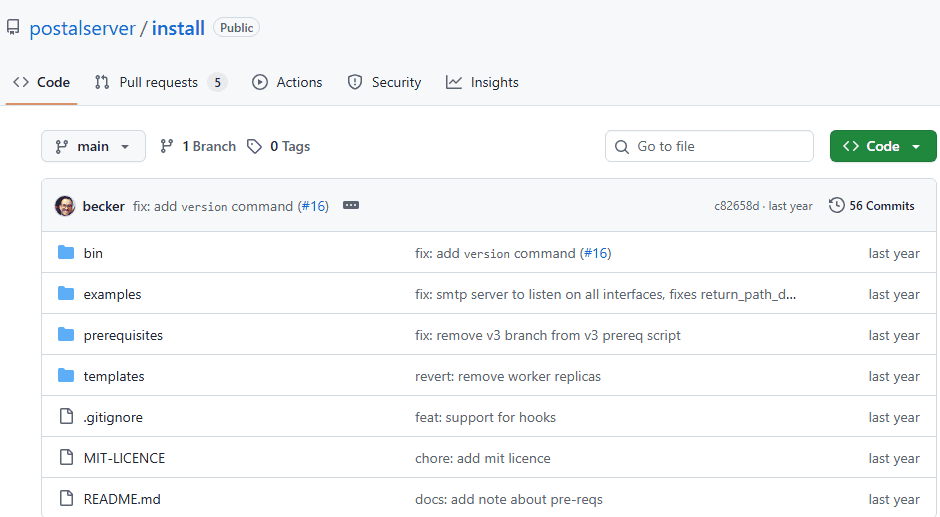
With Postal, you can create mail servers/users for multiple organisations, access outgoing/incoming message queues, real-time delivery information, and built-in features to ensure emails get delivered to your recipients' inboxes.
It’s written in Ruby with MySQL (or MariaDB) and RabbitMQ as its backend dependencies, a bit more resource-heavy than some other STMPs in this list, but in exchange, you get advanced features to manage high-volume email traffic, multi-tenant accounts, and developer-friendly APIs.
Key Features of Postal SMTP
- SMTP & HTTP API
- Inbound Mail Processing
- Tracking & Analytics
- Authentication & Security
- Multi-Account / Multi-Tenant Support
- Web Dashboard
- Built-in DNS checking
- Spam & anti-virus integrations
- Scalability & Performance
- Custom Integrations
- Inbound Mail Routing
- IP Pools
Exim is a highly flexible, open-source SMTP server or Mail Transfer Agent (MTA) used for routing, receiving, and delivering email messages. It was developed at the University of Cambridge in the mid-1990s and has since become one of the most widely deployed MTAs on Unix-like systems (especially Debian and derivatives, where it’s the default.
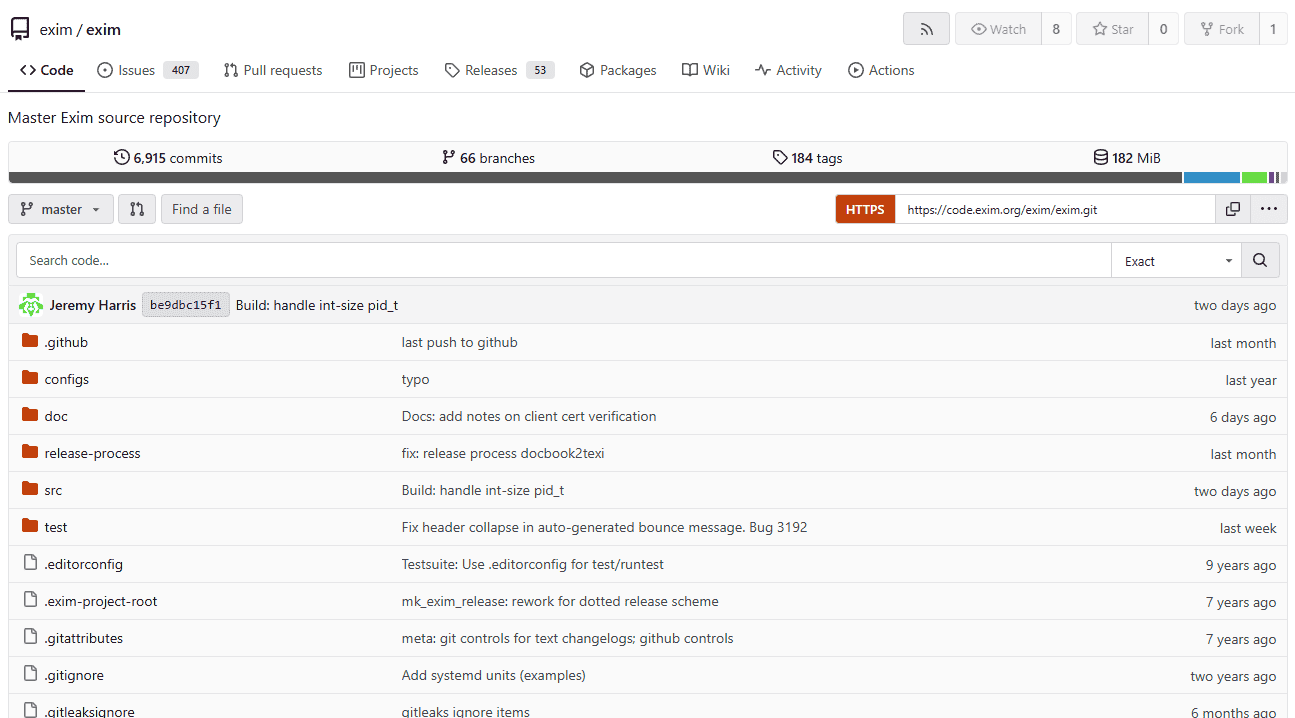
Exim’s reputation comes from its flexibility: almost every part of its behaviour can be configured with rules, conditions, and custom scripts. You can tailor Exim to suit your specific requirements, making it suitable for various email setups, from simple to complex. Its flexibility makes it the number one choice for enterprise-level email servers for organisations.
While not as lightweight as Postfix, it’s a workhorse for mail delivery in ISPs, hosting companies, and organisations that need powerful routing and filtering capabilities.
Key Features of EXIM
- Highly Configurable Routing
- Built-in Support for Modern Email Standards
- Spam & Abuse Protection
- Virtual Hosting & Multiple Domains
- Advanced Logging & Debugging
- ACLs (Access Control Lists)
- Scriptable & Extensible
- Integration Capabilities
- Full Mail Transfer Agent (MTA)
Postfix is one of the world's most popular and widely trusted open-source SMTP servers. Originally developed at IBM Research by Wietse Venema in 1997, it is a secure, fast, and easy-to-administer MTA. Postfix is a reliable and flexible MTA with extensive features and capabilities.
Some key points about Postfix include junk mail control, DB support, and log management. It supports databases like MySQL, Memcached, SQLite, PostgreSQL, and LDAP. Postfix adheres to established email protocols and standards, and works seamlessly with many email clients, servers, and services.
Its reliability and robustness are top-notch. It can handle high email volumes efficiently, making it suitable for small-scale setups and large enterprise environments. Postfix can be scaled to accommodate growing email traffic, which is crucial for organisations that experience increased communication needs.
That's why it powers email delivery on millions of servers, including major ISPs, enterprises, and web hosting companies.
Key Features of Postfix
- High Performance & Scalability
- Security-First Architecture
- Flexible Configuration
- Spam & Abuse Protection
- Supports Modern Email Standards
- Relay & Gateway Capabilities
- Excellent Logging & Debugging
- Reliable Queue & Retry Management
Courier MTA is a free, open-source Mail Transfer Agent that’s part of the Courier Mail Server suite. Unlike Postfix or Exim, which focus on being flexible MTAs and rely on other daemons for mailbox services, Courier provides a complete mail server ecosystem, including SMTP, IMAP, POP3, webmail, mailing list management, and authentication.
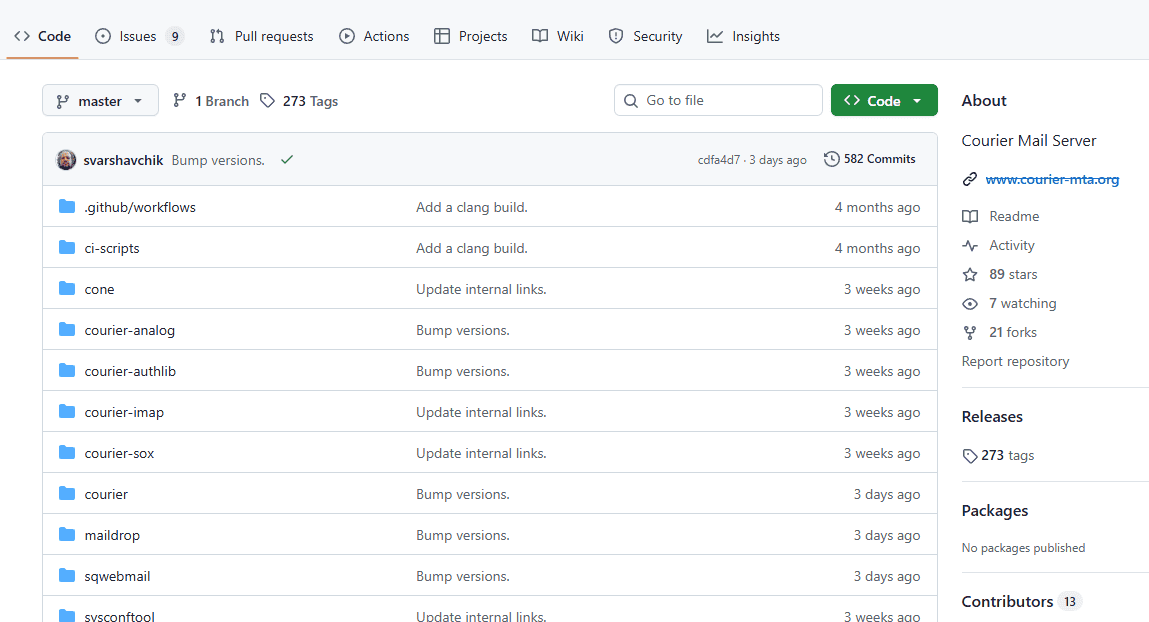
Courier MTA is built to handle a high number of email deliveries, which makes it suitable for both small businesses and large enterprises. It can easily scale as your email needs grow. One of Courier’s standout features is its modular design. Each component of the mail server, such as SMTP, IMAP, and POP3, is a separate module.
Courier MTA supports encrypted connections via TLS (Transport Layer Security), which ensures that emails are transmitted securely. It also offers features like SMTP AUTH, allowing for secure authentication of email clients. The flexibility in configuration means that it can be tailored to suit a wide range of environments, from simple mail servers to complex systems with multiple domains and users.
Courier MTA Features
- Mail Transfer Agent (MTA) functionality
- IMAP and POP3 server support
- ESMTP support with extensions
- Maildir format support
- LDAP, MySQL, PostgreSQL, and DB authentication
- Filtering and quota management
- Mailing list manager
- Greylisting support
- Spam filtering integration
- Modular architecture
- Delivery status notification (DSN) support
- SMTP AUTH support
ZoneMTA (Zone Mail Transfer Agent) is an open-source, Node.js-based SMTP server developed by Andris Reinman (the same guy behind Nodemailer). It is a modern, programmable SMTP relay that you can use to send bulk or transactional emails with flexibility.
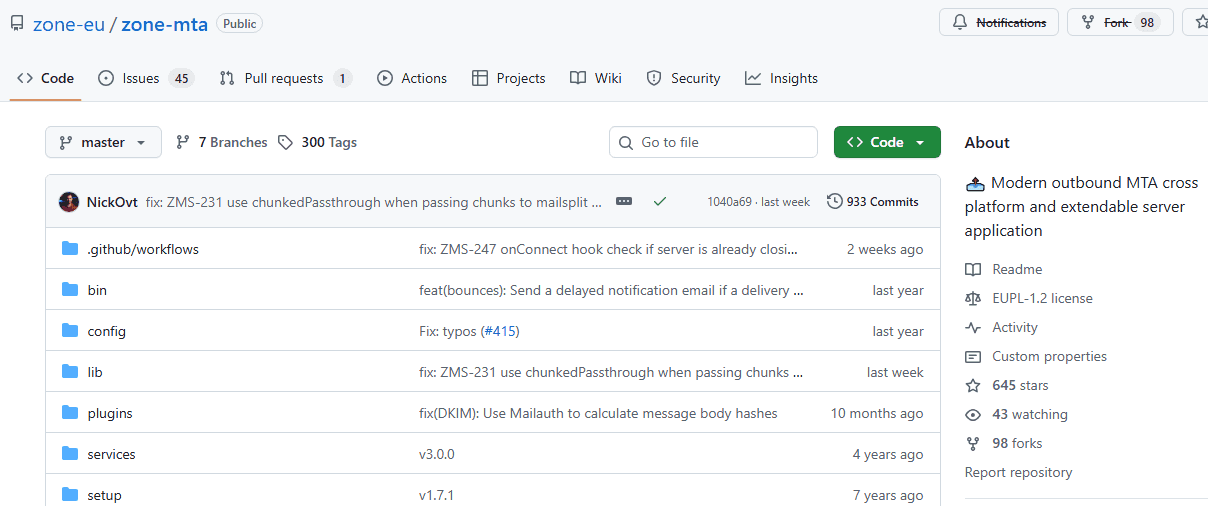
ZoneMTA is built with a modular approach. It’s designed for scalability, customisation, and high-volume sending, perfect for email service providers (ESPs), SaaS platforms, and companies that want fine-grained control over how emails are routed, throttled, and delivered.
If you need excellent email delivery and control beyond what Mailgun or SendGrid offer, ZoneMTA gives you the raw tools to build your own “in-house” sending infrastructure.
ZoneMTA Features
- Modular and extensible architecture
- Built-in support for multiple transports
- REST API for configuration and management
- Webhooks for delivery events
- Support for outbound email relaying
- Message queue management
- Rate limiting and throttling per domain
- IP pool management
- DKIM signing support
- Support for custom plugins
Maddy is a modern, all-in-one open-source SMTP server written in Go (Golang). Unlike most other SMTP servers that require stitching together Postfix, Dovecot, OpenDKIM, SpamAssassin, and half a dozen other tools, Maddy bundles everything into a single lightweight binary to make running your own mail server as simple and reliable as possible.
Instead of fighting endless configuration files and dependencies, you get a single config file that covers SMTP, IMAP, DKIM, SPF, DMARC, filtering, and even local delivery. It’s designed to give you a complete mail server with minimal complexity.
Maddy Features
- All-in-one mail server (SMTP, IMAP, submission)
- Built-in local delivery agent (LDA)
- Virtual domain hosting support
- Authentication via local users, LDAP, SQL,
- TLS encryption (STARTTLS, SMTPS, IMAPS)
- DKIM signing and verification
- SPF and DMARC support
- ARC (Authenticated Received Chain) support
- Outbound SMTP relay support
- Message filtering and rules system
OpenSMTPD is a free and open-source SMTP server developed by the OpenBSD project. Its main purpose is to accept, route, and deliver electronic mail securely and efficiently. Written with security and simplicity as its core philosophy, OpenSMTPD aims to provide a reliable alternative to older, more complex MTAs like Sendmail, Postfix, and Exim.
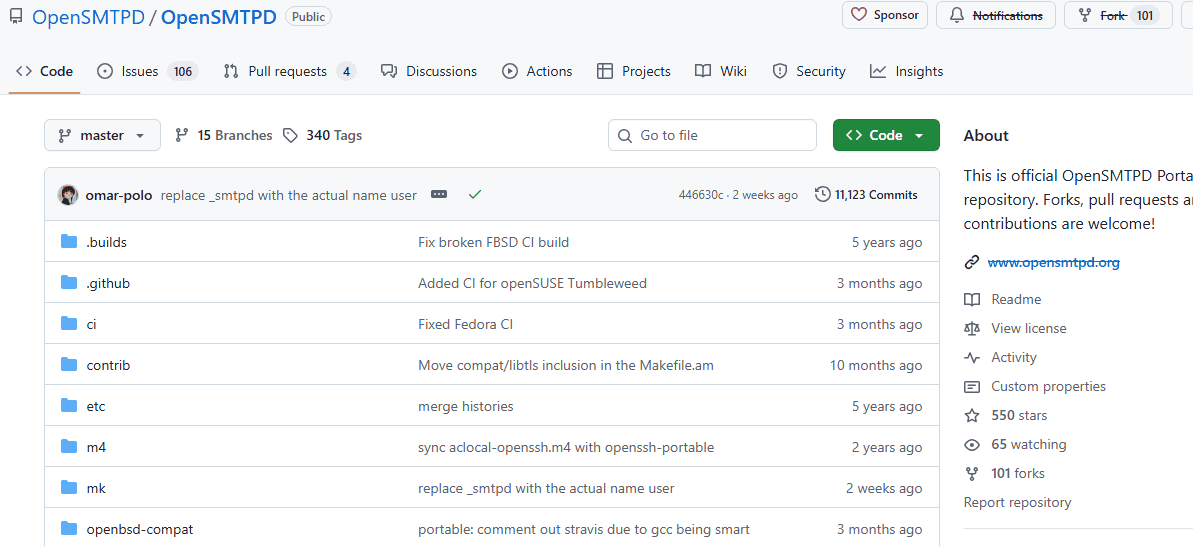
It was first released in 2008 and has grown into a production-ready MTA, compatible with the Simple Mail Transfer Protocol (SMTP) as defined in RFC standards. OpenSMTPD is a lightweight, minimalist MTA, perfect for those who value clean design and security without extra bloat.
OpenSMTPD Features
- SMTP protocol compliance
- Secure by design (privilege separation, chrooting)
- Mail filtering framework
- Support for virtual domains and users
- Flat file, SQL, and LDAP backends
- Logging and monitoring
- TLS/STARTTLS encryption support
- SMTP authentication
- Queue management
- Transparent relay and delivery handling
- Local delivery agent (LDA) support
- Connection limits and throttling
Key Features to Look for in Self-Hosted SMTP Software
Choosing the right self-hosted SMTP software isn’t just about picking the most popular tool. It’s about finding a solution that’s secure, reliable, and fits your technical needs and long-term goals.
Unlike managed email services (like SendGrid or Amazon SES), self-hosted SMTP puts you in control, which means you’re also responsible for setup, maintenance, and security. That’s why it’s crucial to pick software that includes the right features out of the box.
Here are the most important features to look for and why each one matters.
- TLS/SSL Encryption Support
Emails travel across the internet, and without encryption, they can be intercepted or read by third parties. TLS (Transport Layer Security) encrypts the connection between your server and the recipient’s mail server.
Look for an SMTP tool that supports automatic TLS enforcement for outgoing and incoming mail. And that can easily integrate with Let’s Encrypt for free SSL certificates.
- SPF, DKIM, and DMARC Support
These three DNS-based email authentication protocols are essential for email deliverability and preventing spoofing.
- SPF (Sender Policy Framework): Tell the world which servers can send emails from your domain.
- DKIM (DomainKeys Identified Mail) adds a digital signature to your emails so recipients can verify that they weren’t tampered with.
- DMARC (Domain-based Message Authentication, Reporting & Conformance): Tells receiving servers what to do if an email fails SPF or DKIM and sends you reports.
Look for an SMTP server with built-in tools or wizards to generate SPF/DKIM/DMARC records, and support automatic DKIM signing of outgoing emails with DMARC report parsing or integration with monitoring tools.
- Spam & Abuse Protection
Look for an SMTP server with built-in spam filtering or integration with Rspamd, SpamAssassin, or ClamAV for virus scanning. Server with rate limiting to prevent abuse and IP reputation monitoring or blacklist checking.
- Logging, Monitoring & Alerting
When an email fails to send, you need to know why. Was it a DNS issue? A rejected connection? A misconfigured DKIM key? You need an SMTP server with good logging to help you troubleshoot fast and keep your server running smoothly.
Go for an SMTP server with detailed logs for incoming/outgoing mail, authentication attempts, and delivery status. A web-based log viewer or integration with tools like Prometheus, Grafana, or ELK Stack.
- Web-Based Admin Interface
Look for an SMTP server with a clean, intuitive web interface that makes managing users, domains, and settings much easier. Go for a server with a clean dashboard for managing mailboxes, aliases, and domains. And that will give you easy access to DKIM keys, TLS settings, and logs with role-based access (e.g., admin vs. user permissions).
- API & CLI Support
If you want to integrate your SMTP server with applications, websites, or automation tools, you should choose a server that supports RESTful APIs, CLIs, and webhooks for tasks, such as; sending emails, managing users, checking statistics, automating scripts and servers, and handling bounce, complaint, and delivery notifications.
- Database & Multi-Domain Support
If you need to store user accounts, settings, or logs in a structured way, then you need software that supports databases and multi-tenancy. So go for SMTP that supports MySQL, PostgreSQL, or SQLite with the ability to manage multiple domains from one dashboard.
Final Thoughts
Self-hosted SMTP isn’t just for tech enthusiasts or large enterprises; it’s a practical, secure, and cost-effective solution for anyone who values control over their email communication. If you value control over your email infrastructure, open-source SMTP servers give you the power to customise, scale, and secure your sending environment without depending on third-party restrictions.
Open-source, and self-hosted SMTP software helps you eliminate reliance on third-party providers, reduce long-term costs, and gain transparency over how your emails are sent and managed. Whether sending password resets, transactional alerts, or marketing campaigns, owning your email infrastructure means better privacy, improved deliverability, and long-term flexibility.
Each open-source SMTP server in this list has unique strengths, and the best choice depends on your technical expertise, email volume, and specific requirements. For mission-critical systems, Postfix and Exim offer proven reliability. However, if email is central to your business operations, Postal and ZoneMTA are loaded with enterprise-grade sending power without limitation.




0 Comments